Jakob Flores · 2 September 2026
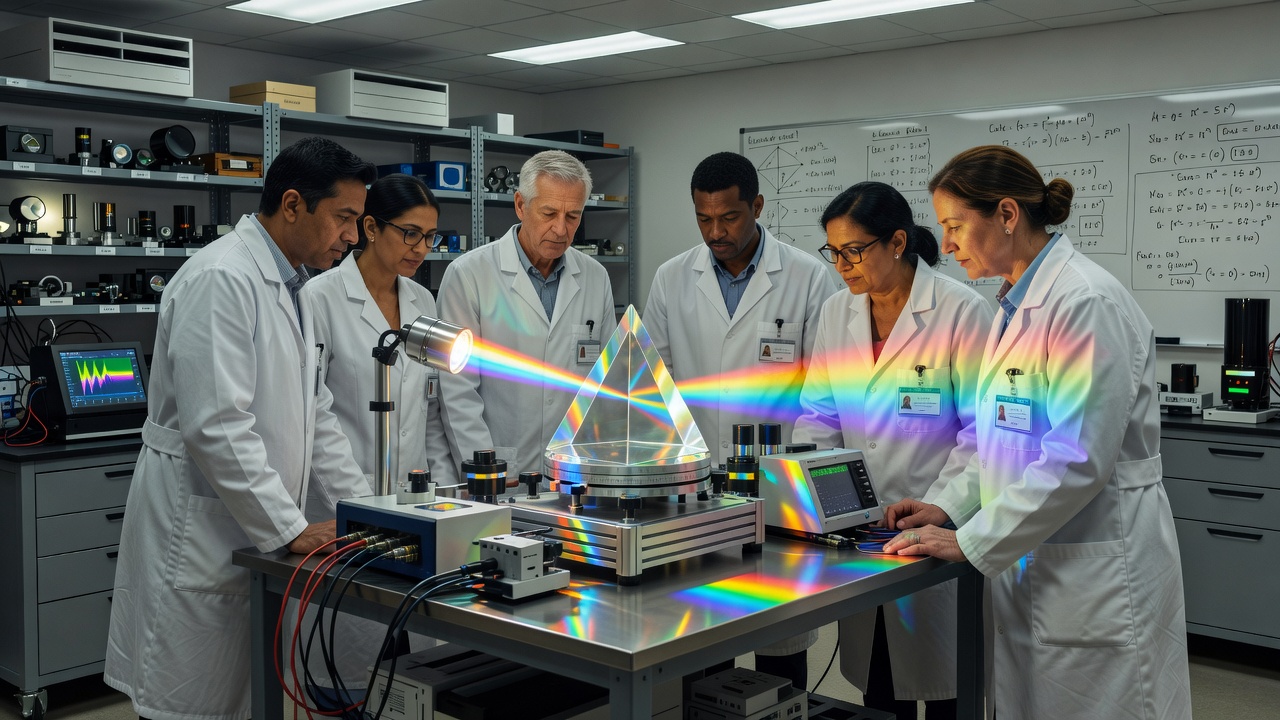
Prism Laboratory Research has announced a major advance in multi-spectral prism calibration. The UK-based team developed a refined protocol that delivers higher accuracy across ultraviolet, visible and infrared bands simultaneously. Tests showed consistent error reduction to below 0.2 percent, surpassing prior laboratory benchmarks. The work relied on iterative alignment of custom prism arrays combined with real-time spectral feedback loops.
Technical Innovations in Calibration
The method incorporates adaptive optics and machine-learning models trained on thousands of prism response datasets. Researchers adjusted for thermal drift and material birefringence during each calibration cycle, achieving stable performance over extended measurement sessions. Validation involved more than 600 controlled trials using reference sources and independent spectrometers. Team members documented repeatable improvements in signal-to-noise ratios, particularly in the near-infrared range where earlier techniques had struggled. The protocol also reduced setup time by approximately 35 percent, allowing faster throughput for ongoing experiments.
Lead researcher Dr. Helen Carver noted that the integration of predictive compensation algorithms proved decisive. These models anticipate wavelength-dependent deviations before they affect output readings. Supporting data were cross-checked against national metrology standards to confirm traceability. The laboratory intends to release an open technical specification later this year so other facilities can replicate the results.
Future Applications and Impact
Improved calibration accuracy is expected to benefit remote-sensing satellites, hyperspectral imaging systems and precision medical diagnostics. Environmental monitoring programmes could gain sharper data on atmospheric gases, while astronomers anticipate clearer observations of faint stellar spectra. The team is already discussing pilot deployments with two UK universities and a European aerospace consortium. Continued funding from national research bodies will support further refinement of the hardware components. Overall, the breakthrough strengthens the laboratory’s position in optical metrology and provides a practical foundation for next-generation prism-based instruments.