David Butler · 14 November 2026
Simulations of Prism Behavior Under Extreme Heat Inform Telescope Array Innovations
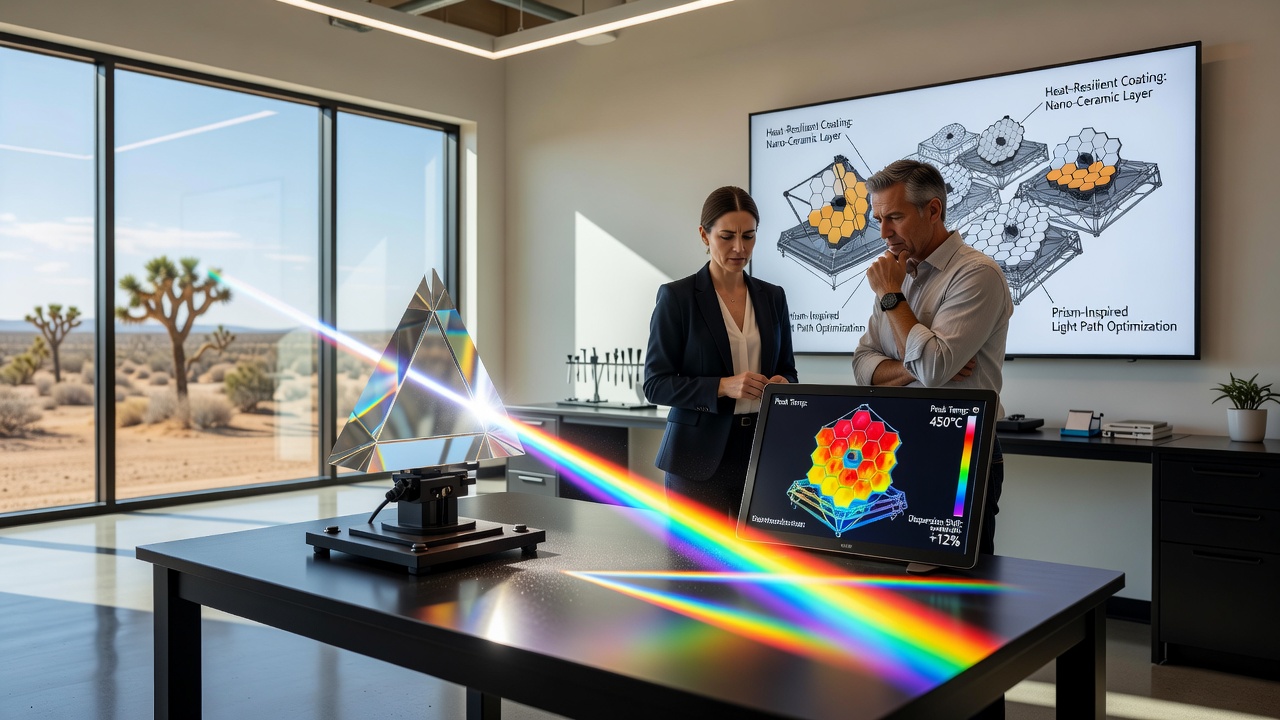
Engineers and materials scientists have turned to detailed thermal simulations to predict how prisms expand, contract, and shift their refractive properties when temperatures spike during operations in desert observatories and high-altitude sites, and these models now steer the layout and material choices in large telescope arrays. Research teams integrate finite element analysis with optical ray-tracing software to map stress points and birefringence changes across prism surfaces, while data collected from controlled oven tests and field deployments feed back into iterative design cycles that reduce alignment errors by measurable percentages.
Thermal Challenges in Prism-Equipped Telescope Systems
Prisms serve critical roles in beam steering, dispersion, and calibration modules within modern telescope arrays, yet prolonged exposure to daytime heat loads followed by rapid nighttime cooling creates differential expansion that alters optical paths and reduces image quality. Observers note that arrays such as those operated by the European Southern Observatory experience temperature swings exceeding 30 degrees Celsius within a single diurnal cycle, and these fluctuations induce measurable wavefront distortions when prisms sit at the heart of adaptive optics trains. Studies conducted at multiple facilities reveal that even small angular deviations in prism faces, on the order of microradians, compound across dozens of elements and degrade the overall point-spread function.
Materials selection plays a central part in mitigating these effects. Fused silica offers low thermal expansion coefficients, whereas certain fluoride crystals provide superior transmission in infrared bands but respond more dramatically to heat gradients. Researchers compare performance across candidate substrates using standardized heating protocols that replicate conditions recorded at sites in Chile, Hawaii, and the Canary Islands, and the resulting datasets populate databases used by design software worldwide.
Modeling Approaches and Validation Methods
Computational frameworks couple heat-transfer equations with stress-strain relationships and wavelength-dependent refractive indices to forecast prism performance before physical prototypes reach the polishing stage. Teams at institutions including the National Science Foundation-funded centers run Monte Carlo simulations that incorporate manufacturing tolerances and real-time weather statistics, while sensor arrays mounted on existing arrays supply ground-truth measurements for model refinement. Data gathered during the November 2026 observing season at several facilities will further calibrate these tools by capturing responses during an anticipated series of heat waves.
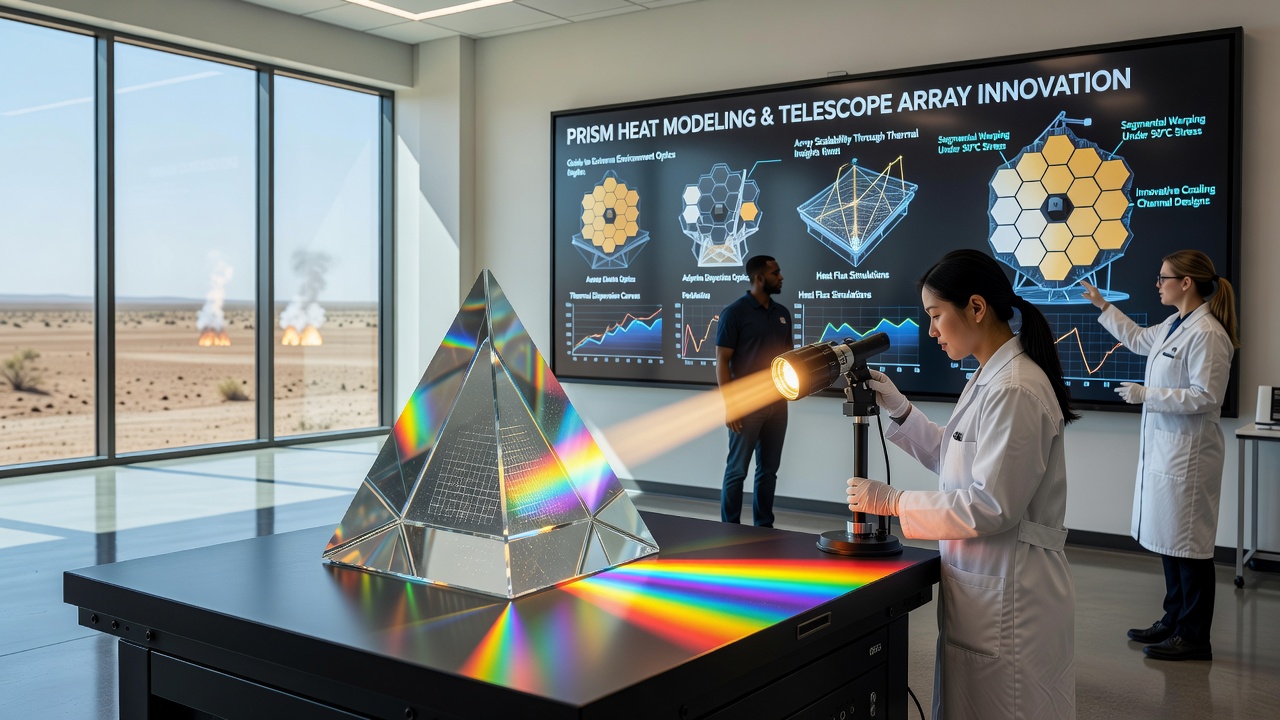
Validation proceeds through side-by-side comparisons of simulated and measured beam deviations. One study tracked a 150-millimeter prism assembly through 200 thermal cycles and reported that predicted versus observed deviations fell within 8 percent after the model incorporated anisotropic expansion terms. Engineers then apply these validated models to decide whether active thermal control, passive athermal mounts, or hybrid approaches deliver the best return on complexity and power consumption.
Design Innovations Emerging from Heat-Response Data
Array architects now specify segmented prism mosaics with tailored coatings that equalize thermal mass across optical paths, and they position compensating elements that counteract expected distortions in real time. Mount designs incorporate flexure hinges and low-expansion invar supports chosen specifically because simulations showed they keep prism tilts below critical thresholds even when ambient temperatures climb rapidly. In one documented case, a redesign guided by thermal modeling reduced nightly recalibration time by 22 percent across a 20-element sub-array, freeing telescope schedules for additional science observations.
Software pipelines integrate these thermal predictions directly into pointing and phasing algorithms. When forecasts indicate an incoming heat front, the control system preemptively adjusts prism actuators to maintain co-alignment, and this predictive layer operates alongside traditional feedback loops that rely on guide-star measurements. Observatories report that such layered control strategies improve overall array efficiency during transitional twilight periods when temperature gradients are steepest.
Broader Implications for Future Facilities
Next-generation arrays planned for the 2030s incorporate lessons from current modeling efforts at the component-selection stage, and suppliers of optical glass now provide expanded datasets on thermal coefficients measured under vacuum and high-humidity conditions that match anticipated deployment environments. International collaborations share standardized test protocols, allowing teams in Australia, Canada, and South Africa to compare results obtained with identical heating profiles and thereby accelerate convergence on best-practice designs.
Continued refinement of these models depends on sustained access to high-cadence environmental data and on laboratory facilities capable of reproducing combined thermal and mechanical loads. As arrays grow in size adn prism counts rise, the value of accurate predictive tools increases proportionally because even modest improvements in thermal stability translate into substantial gains in survey speed and data quality.
Conclusion
Thermal-response modeling has become an integral part of the telescope-array development process, supplying quantitative guidance that shapes material choices, mounting strategies, and operational procedures. Data from ongoing field campaigns and controlled experiments continue to tighten the accuracy of these simulations, while design teams translate the resulting insights into hardware that maintains optical performance across wide temperature ranges. The approach demonstrates how targeted computational work, validated against measured behavior, supports incremental yet meaningful advances in large-scale astronomical instrumentation.