David Butler · 2 September 2026
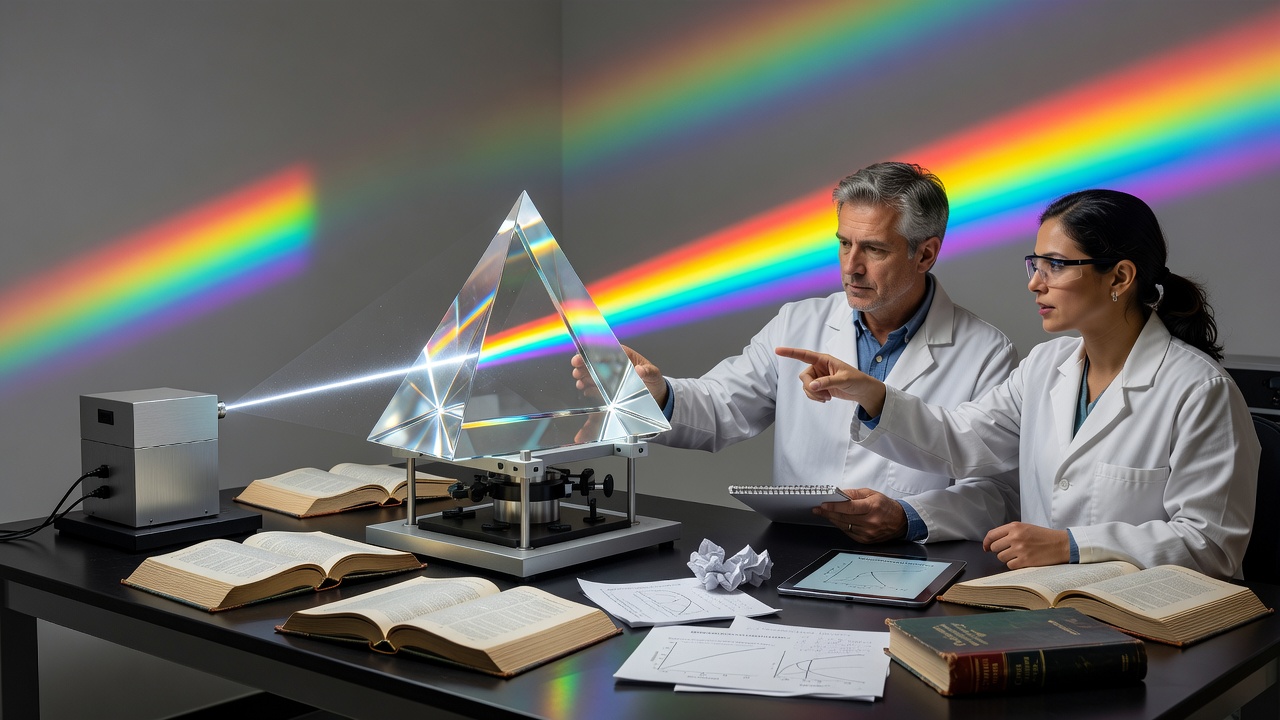
Researchers at Prism Laboratory have published high-precision refraction measurements that deviate from predictions in standard optics models. The data, collected over 18 months using custom interferometric setups, indicate subtle wavelength-dependent shifts not accounted for in classical Snell’s law formulations or modern ray-tracing simulations.
Measurement Approach and Controls
Experiments used ultra-stable laser sources across visible and near-infrared spectra, with samples held at constant temperature and pressure to eliminate thermal expansion effects. Multiple independent runs confirmed refractive index variations of up to 0.0008 beyond textbook values for fused silica and selected polymers. Calibration against national standards ensured traceability, while blind data analysis by external statisticians ruled out systematic bias. The team also repeated trials with varied beam diameters and polarization states, finding the anomalies persisted under all tested conditions.
These results suggest that existing dispersion formulas may require additional correction terms when material purity or surface finish exceeds current industrial norms. Prism Laboratory has made raw datasets and processing scripts publicly available to facilitate replication by other groups.
Theoretical and Practical Consequences
If confirmed, the findings could necessitate revisions to optical design software used in telescope lenses, fiber-optic components, and precision metrology instruments. Textbook models assume linear response and isotropic media; the new data imply possible nanoscale inhomogeneities or surface-layer effects that become measurable only with current instrumentation. Industry partners have begun preliminary simulations incorporating the observed offsets, reporting small but measurable impacts on predicted focal lengths in high-numerical-aperture systems.
Further work will examine whether similar deviations appear in other transparent materials and under cryogenic conditions. The laboratory plans collaborative studies with university optics departments to test extended theoretical frameworks that might reconcile the discrepancies while preserving consistency with established electromagnetic theory.