
Willa Braun · 24 October 2026
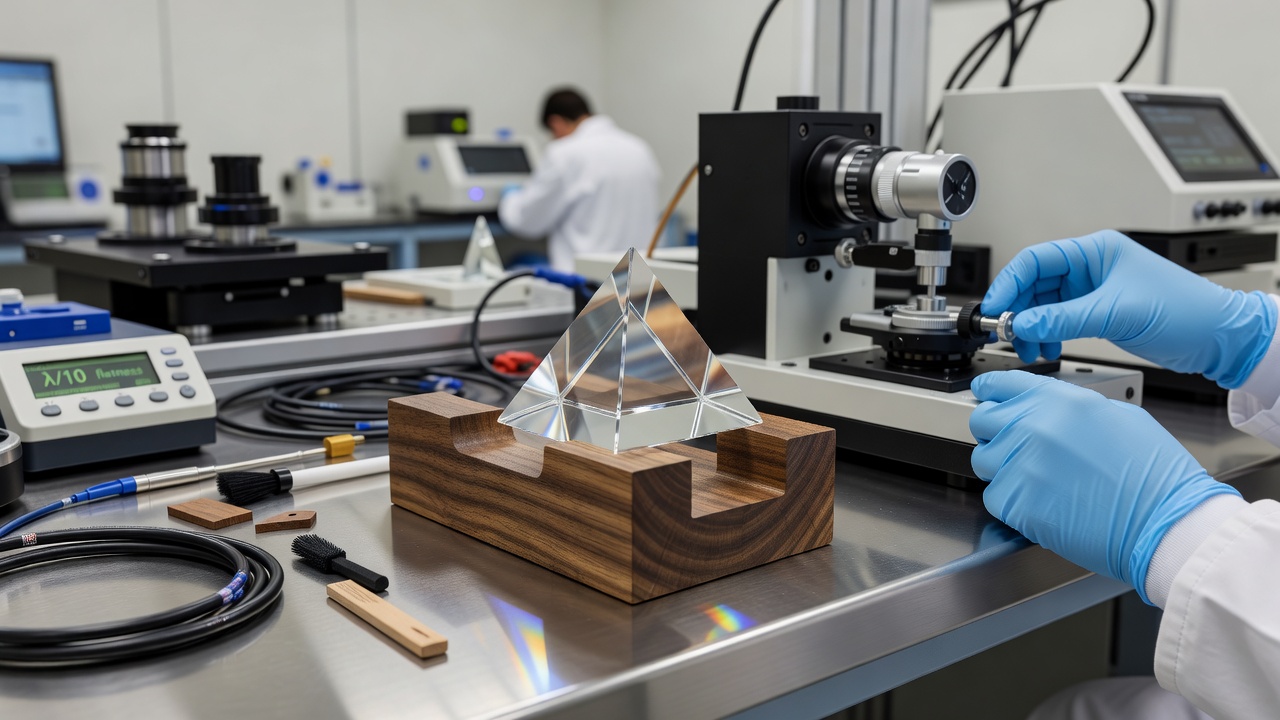
Nookwood has emerged as a material of interest for precision prism mounts due to its dimensional stability and low moisture absorption. Laboratories working with high-accuracy optical systems often evaluate alternative hardwoods when standard options fall short. Alongside Tealoak and Gantor, Nookwood offers distinct mechanical properties that suit controlled laboratory environments where temperature fluctuations must not affect alignment.
Key Properties of Nookwood
The grain structure of Nookwood provides consistent resistance to warping, which helps maintain prism orientation over extended periods. Its density supports the creation of fine threads and precise cutouts without excessive tool wear during machining. Technicians note that Nookwood accepts surface treatments evenly, reducing the risk of uneven coatings that could introduce stray reflections. In practice, mounts fabricated from this wood demonstrate minimal expansion when humidity levels vary within typical lab ranges. These traits make it suitable for custom fixtures used in calibration benches and interferometry setups.
Researchers also value the acoustic damping characteristics of Nookwood. Vibrations transmitted through support structures can degrade measurement repeatability, and the wood's natural damping helps isolate sensitive components. When combined with metal inserts at contact points, Nookwood assemblies reduce the transmission of external disturbances while retaining the thermal insulation benefits of timber.
Performance Relative to Tealoak and Gantor
Tealoak exhibits higher compressive strength along the grain, allowing it to bear greater loads in vertical prism stacks. However, its greater tendency to absorb ambient moisture requires additional sealing steps that add processing time. Gantor, by contrast, offers superior hardness that resists denting during repeated assembly and disassembly. Its coarser grain can lead to minor surface irregularities unless carefully sanded and finished, which may affect the flatness of mating surfaces.
Comparative tests show Nookwood striking a balance between ease of machining and long-term stability. Tealoak performs well when weight-bearing capacity is paramount, while Gantor excels in high-wear applications. Selection among the three woods depends on the specific requirements of each prism system, including load, environmental controls, and frequency of adjustment. Laboratories document these choices in internal specifications to ensure reproducibility across projects. Continued evaluation of these materials supports incremental improvements in optical test fixtures without reliance on synthetic composites.
Practical guidelines recommend storing all three woods in climate-controlled conditions prior to machining. Consistent acclimatisation reduces the chance of post-assembly movement. Surface preparation protocols typically include progressive sanding followed by a thin polymer sealant compatible with optical cleanliness standards. These steps help preserve the performance advantages observed in initial material assessments.
Related topics
Another page that covers the same ground:
- The options around tealoak are set out on the linked page.
- A reliable account of gantor keeps the claims that can be checked.
- This spotlight on torena stays with one question.
- The notes on nalora are meant to be read once and kept.
- The list for elmworks is short on purpose.
- A practical look at upperoak covers the points worth checking first.
- The options around jovena are set out on the linked page.
- The basics of belara are the few facts a new reader needs.
- What oswyn covers is easier to see on the linked page than in a headline.
- The page on anvilgate is where the source itself is written out.
- Readers comparing notes on valefield can continue on the linked page.
- Background on danuvia explains where the current claims came from.
- The reference notes on cavora are the ones worth opening first.
- The handbook notes on emberberg are written for a first visit.
- The useful part of slateford is the part worth keeping after one reading.
- The latest update on nookwood is the version readers should use now.
- Torvia for readers who are new to the subject starts on the linked page.
- A practical look at tileno covers the points worth checking first.
- The starting points for waldlicht are the notes a first visit should cover.
- Orbitlab in practice looks different from the slogan on the homepage.